
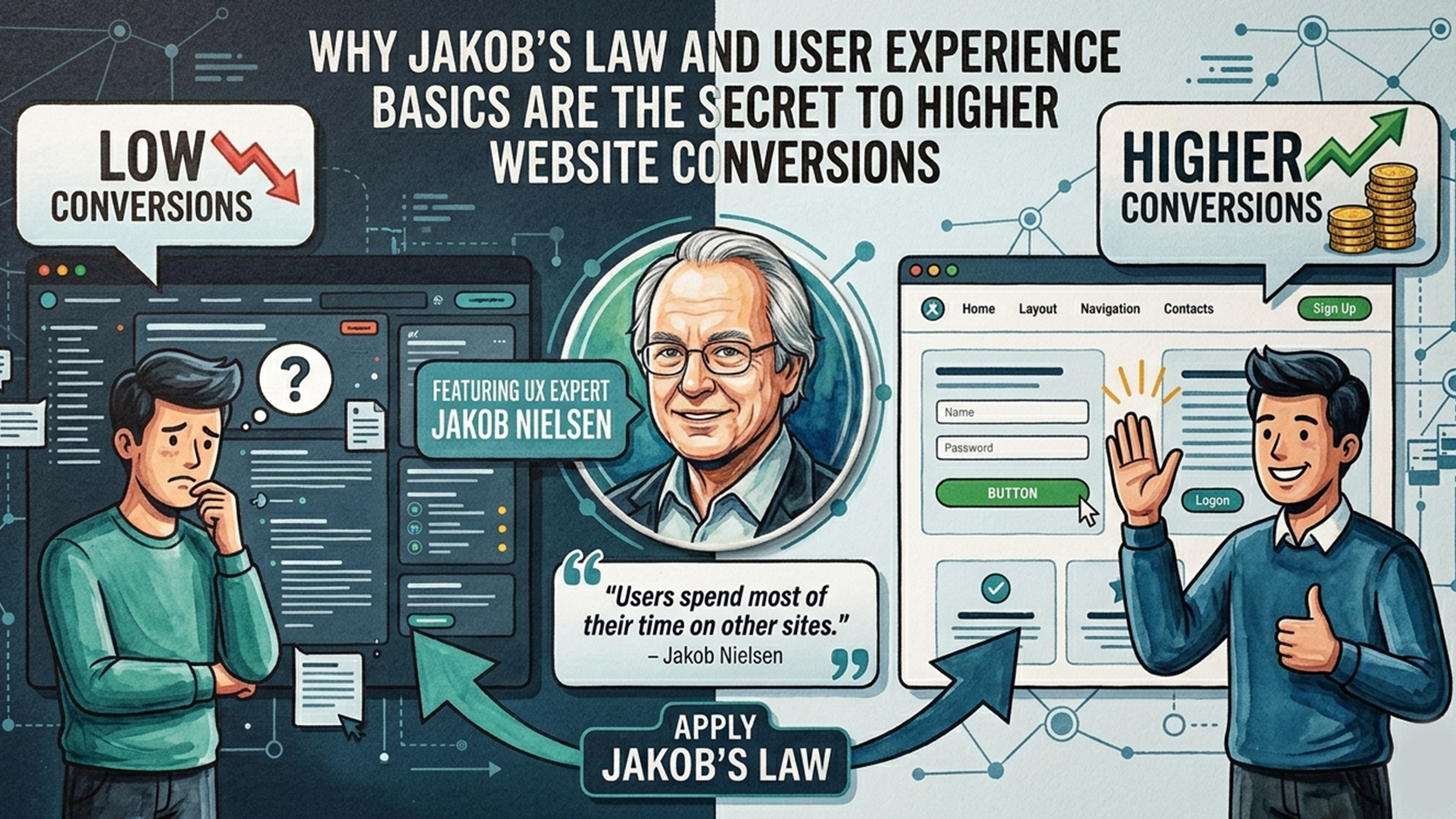
Did you know your website’s design could make or break your marketing success? It often comes down to a fundamental principle of human behavior and user experience (UX) basics known as Jakob’s Law.
Jakob’s Law, coined by web usability pioneer Jakob Nielsen, states that users spend most of their time on other websites. Because of this, they expect your site to work the exact same way as all the others they already know.
Jakob’s Law states that users spend most of their time on other websites. Because of this, they expect your site to work the exact same way as all the others they already know.
Leveraging these existing mental models reduces cognitive load, simplifies navigation, and makes familiarity the ultimate winner in web design. When users know what to expect, they navigate your site with ease, stay longer, and are far more likely to convert.
Watch the video: Why Jakob’s Law is the Secret to Higher Website Conversions
Why Familiarity Wins in Digital Marketing
Many businesses make the mistake of trying to completely reinvent the wheel with their web design. They use unconventional layouts, hidden navigation menus, or strange phrasing in an effort to look unique.
For home service providers, this mistake is incredibly costly. If you are trying to optimize an HVAC website design or looking for ways to boost your plumbing landing page conversion rate, clarity must always beat cleverness. When a homeowner has a burst pipe or a broken AC unit in the middle of July, they have zero cognitive patience. They don’t want a “revolutionary digital portal”—they want a visible phone number and an instant booking form.
A smooth, familiar user experience directly leads to higher engagement, lower bounce rates, and increased conversion rates. By designing for predictability, you remove friction from the buyer’s journey.
UX Basics: Standard Design Patterns Users Expect
- The Logo Location: Visitors expect your logo in the top-left corner or center, and they expect clicking it to take them back to the homepage.
- Navigation Menus: Navigation headers should stay at the top of the page, with clear labels like “Services,” “About,” and “Contact.”
- The Shopping Cart: For e-commerce or booking sites, the cart or checkout icon belongs in the top-right corner.
- Contact Forms: Simple forms with standard fields (Name, Email, Phone) located on a dedicated contact page or in the footer.
Jakob’s Law in Action: Home Service Case Studies
To see how these user experience basics directly impact your bottom line, let’s look at how high-converting HVAC website design, plumbing marketing, and electrician marketing landing pages look compared to layouts that lose leads.
1. HVAC Website Design: The “Schedule Now” Friction Test
When a homeowner’s air conditioning cuts out in July, they search with intense intent. They aren’t looking to read a company manifesto; they want an instant fix.
- The Familiar Pattern (High Conversion): A clear, high-contrast button that reads “Schedule AC Repair” placed prominently in the top right header of the page. The user immediately knows how to take action.
- The Over-Complicated Design (High Bounce Rate): Forcing users to click into a generic drop-down menu labeled “Comfort Solutions” just to find an inquiry form. Extra clicks lead to lost customers.
2. Plumbing Marketing: Emergency Landing Page Layouts
A burst pipe requires immediate attention. If your plumbing landing page conversion tips don’t account for panic, you’re losing money to the competitor down the street.
- The Familiar Pattern (High Conversion): A dedicated, uncluttered landing page built specifically for 24-hour emergency plumbing. The absolute first thing the user sees is a massive, click-to-call phone number.
- The Over-Complicated Design (High Bounce Rate): Sending emergency traffic to a standard “About Us” page that forces a stressed user to scroll past your origin story and a list of commercial remodeling services before finding a phone number.
3. Electrician Marketing: Managing Complex Service Pillars
Electrical contractors often handle highly distinct services—like residential panel upgrades on one hand and commercial build-outs on the other.
- The Familiar Pattern (High Conversion): A clean, intuitive navigation bar that breaks your business down into distinct, easily recognizable service pillars (e.g., “Residential Services” and “Commercial Contracting”).
- The Over-Complicated Design (High Bounce Rate): Shoving fifty different services separated only by commas into a massive, unreadable wall of text on a single page. Users get overwhelmed by the wall of text and click away.
How to Integrate Jakob’s Law into Your Strategy
You don’t have to sacrifice creativity to build a familiar website. Instead, focus your unique branding, messaging, and visuals within a structural framework that users already understand.
Here is how you can implement Jakob’s Law effectively:
- Analyze Industry Leaders: Look at the most popular, high-traffic websites in your specific industry. Take note of where they place elements and how they structure their user journeys.
- Identify Common Patterns: Pinpoint the recurring layouts, navigation systems, and icons that your target audience interacts with every day.
- Keep Language Simple: Avoid clever or cryptic labels. Use standard terms like “Get a Quote” or “Log In” so users don’t have to guess what happens next.
Consistency in layout, navigation, and language makes your audience feel right at home. This immediate comfort level boosts user trust, satisfaction, and confidence in your brand.
Frequently Asked Questions About UX Basics
Does Jakob’s Law mean all websites should look identical?
Not at all. Jakob’s Law applies to how a site functions, not its visual identity. You can use distinct photography, custom color palettes, and compelling brand copy while still keeping your layout intuitive and easy to use.
What happens if I break Jakob’s Law?
When you break the law of familiarity, you increase user frustration. Visitors who get confused or lose patience will click away and head to a competitor’s site that behaves exactly the way they expect.
Build a Digital Experience That Converts
Think about your favorite websites for a moment. Why do you actually enjoy using them? Is it because they are unpredictable, or because they make finding information completely effortless? Share your thoughts via social media.
If you want a marketing strategy and web design that truly captivates users without causing frustration, the team at Biondo Creative is here to help. We specialize in crafting familiar, highly functional, and powerful digital experiences that turn casual traffic into loyal customers.
Ready to grow your business? Learn more about our Web Design Services, Contact Us or give us a call today at 267-362-9321 to see how we can optimize your online presence.