
Both Google Ads and Facebook Ads can generate new clients for a therapy practice. They work in fundamentally different ways, and understanding the difference is the key to spending your mental health marketing budget well.
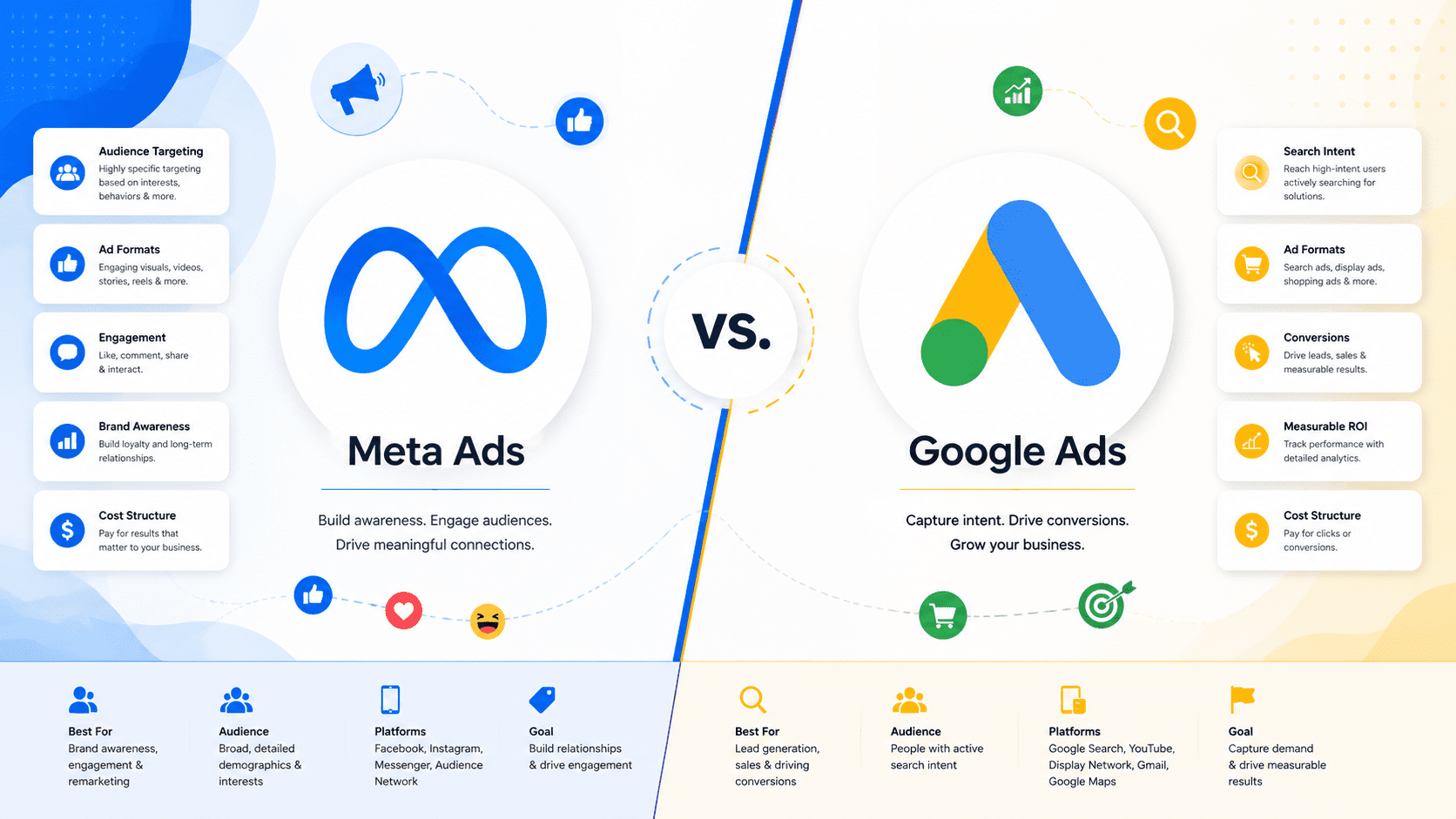
Here’s the short short version: Google Ads captures clients who are already looking for therapy. Facebook Ads introduces your practice to people who weren’t. One meets demand. The other creates it. Both have a place in a well-rounded marketing strategy — but they’re not interchangeable.
How Each Platform Works
Google Ads: Intent-Based Advertising
Google Ads shows your ads to people based on what they’re actively searching for. When someone types “anxiety therapist near me” or “marriage counseling in Nashville,” Google runs an auction and shows ads from therapists who are bidding on those terms.
The defining characteristic: intent. The person is already looking for what you offer. They’ve decided they want therapy or at least that they want to explore it — and they’re using Google to find a provider.
Facebook (and Instagram) Ads: Interest-Based Advertising
Facebook Ads show your ads to people based on demographics, interests, behaviors, and life events — not what they’re searching for. You can target people in your city who are interested in mental health topics, who fall into certain age groups, who’ve recently experienced major life changes, and so on.
The defining characteristic: audience targeting. You’re reaching people based on who they are and what they’re interested in, not based on an active search. They may or may not be thinking about therapy right now.
When Google Ads Is the Better Choice
You want clients now.
Google Ads is the faster channel. Because you’re targeting people who are actively searching, a well-run campaign can generate consultation requests within the first week.
You offer a specific specialty.
If someone is searching for “EMDR therapist” or “DBT therapy for teens,” Google Ads lets you show up at exactly that moment. That specificity is hard to replicate with interest-based targeting.
You’re in a market with consistent search volume.
Therapists in cities with enough search traffic for their specialty will find Google Ads efficient because the demand already exists.
You have a solid website, landing page and Google Business Profile
Google Ads traffic converts best when it lands on a focused, fast, well-designed page. If your web presence is strong, Google Ads can be highly efficient.
When Facebook Ads Is the Better Choice
You want to reach people who don’t yet know they need therapy.
Some potential clients are struggling but haven’t searched for a therapist yet. A well-crafted Facebook ad can reach them at the right moment — a message about managing anxiety that shows up for someone who follows several mental health accounts, for example.
You want to build brand awareness in your community.
Facebook and Instagram allow geographic targeting that makes it possible to put your practice in front of a large local audience at relatively low cost. Even if people don’t click immediately, they start recognizing your name.
Your specialty lends itself to visual storytelling.
Instagram, in particular, works well for therapists whose content is visually oriented — mindfulness, wellness, relationships, parenting. If you have strong visual content or short videos, Facebook/Instagram advertising can extend that reach.
You have a lower budget and want broader reach.
CPCs on Facebook are generally lower than on Google for therapy-related targeting. You can reach more people for less money — though those people are less likely to convert immediately.
The Cost Question
On a per-click basis, Facebook Ads are usually cheaper. A click on a Facebook or Instagram ad might cost $1–$5 for a well-targeted therapy audience. A Google click for a competitive therapy keyword might cost $10–$30.
But cost per click isn’t the right metric to compare. The right metric is cost per client acquired — how much you spent in total advertising to get one booked client.
Because Google Ads traffic is higher intent, it tends to convert at a higher rate. A $20 Google click from someone actively searching for a therapist often outperforms a $3 Facebook click from someone passively scrolling, because the Google searcher is already motivated to take action.
In practice, cost per client acquired often ends up roughly comparable between the two channels or slightly favoring Google for most therapy practice types.
Which Platform Should You Start With?
If you have to choose one to start:
Start with Google Ads if:
- You need clients quickly
- You’re in a market with meaningful search volume for your specialty
- You have a good website and landing page
Start with Facebook/Instagram Ads if:
- You want to build a local audience and brand recognition
- Your specialty is more discovery-driven (general life coaching, wellness, preventive mental health)
- You want to test visual or video content to build trust before asking for a booking
Run both if:
- You have a budget that supports it ($1,500+/month combined)
- You want to capture both the “ready to book now” audience and the “building awareness” audience
- You have the time or support to manage and optimize two separate campaigns
So what about Retargeting?
Retargeting is showing ads to people who’ve already visited your website — is worth mentioning here because it’s often more effective than cold traffic on Facebook/Instagram.
Someone who visited your website and didn’t book has already shown interest. A retargeting ad reminding them you exist, perhaps with a softer CTA (“Learn more about working together”), can bring a meaningful percentage of those visitors back.
Just be thoughtful about the sensitivity of mental health retargeting. Make sure your ads don’t feel intrusive or reveal that someone visited a mental health site to other people who might see their screen.
Frequently Asked Questions
Can I run both platforms at the same time?
Yes, and many practices do. Google captures active demand while Facebook builds awareness. They’re most powerful together.
What about Instagram specifically?
Instagram ads are run through Facebook’s ad platform (Meta Ads Manager), so they share the same targeting options and budget. Instagram tends to perform better for visual content and younger audiences, while Facebook has broader reach across age groups.
Do I need a big creative budget for Facebook Ads?
Not necessarily. Many high-performing therapy ads on Facebook are simple — a professional photo of the therapist or their office, a clear headline about what they help with, and a direct call to action. Production value matters less than clarity and relevance.
Need help deciding which platform is right for your practice? Biondo Creative manages Google Ads and Facebook Ads campaigns for therapy practices, and can help you build a paid strategy that fits your budget and goals.